




The biggest problem in most companies isn’t data, talent, or strategy; it’s fragmentation. Every department optimizes for its own scorecard, and no one owns the connective role that brings it all together.
In 2026, that job belongs to marketing.
Contents:
Why Marketing Is the Only Team Built to Align the Business
The New Marketing Operating Model: Functional Orchestration
What It Looks Like When the Bridge Works
The Great Marketing Reframe

Why Marketing Is the Only Team Built to Align the Business
Marketing is the only function with clear, ongoing visibility into both how your internal engine works and what the external market thinks.
When done well, marketing acts as a translator:
|
Marketing Converts… |
Into… |
|
Internal value (product, ops data, finance) |
External credibility (trust, demand, valuation) |
|
Metrics (acquisition cost, win rate, engagement) |
Meaning (credibility, authority, culture) |
|
External signals (market shifts, buyer intent) |
Internal actions (enablement, roadmap, targeting) |
|
Company behavior (comms, branding) |
Market belief (growth story, category leadership) |
But the true power of marketing goes beyond internal/external translation. It’s also the most natural connector within an organization. Marketing is typically an “internal vendor,” responsible for supporting (and as a result, sitting at the intersection of) many other functions.
No other department is positioned to see as broadly across both a company and its market. And that unique perspective creates a critical opportunity for those who recognize it.
The New Marketing Operating Model: Functional Orchestration
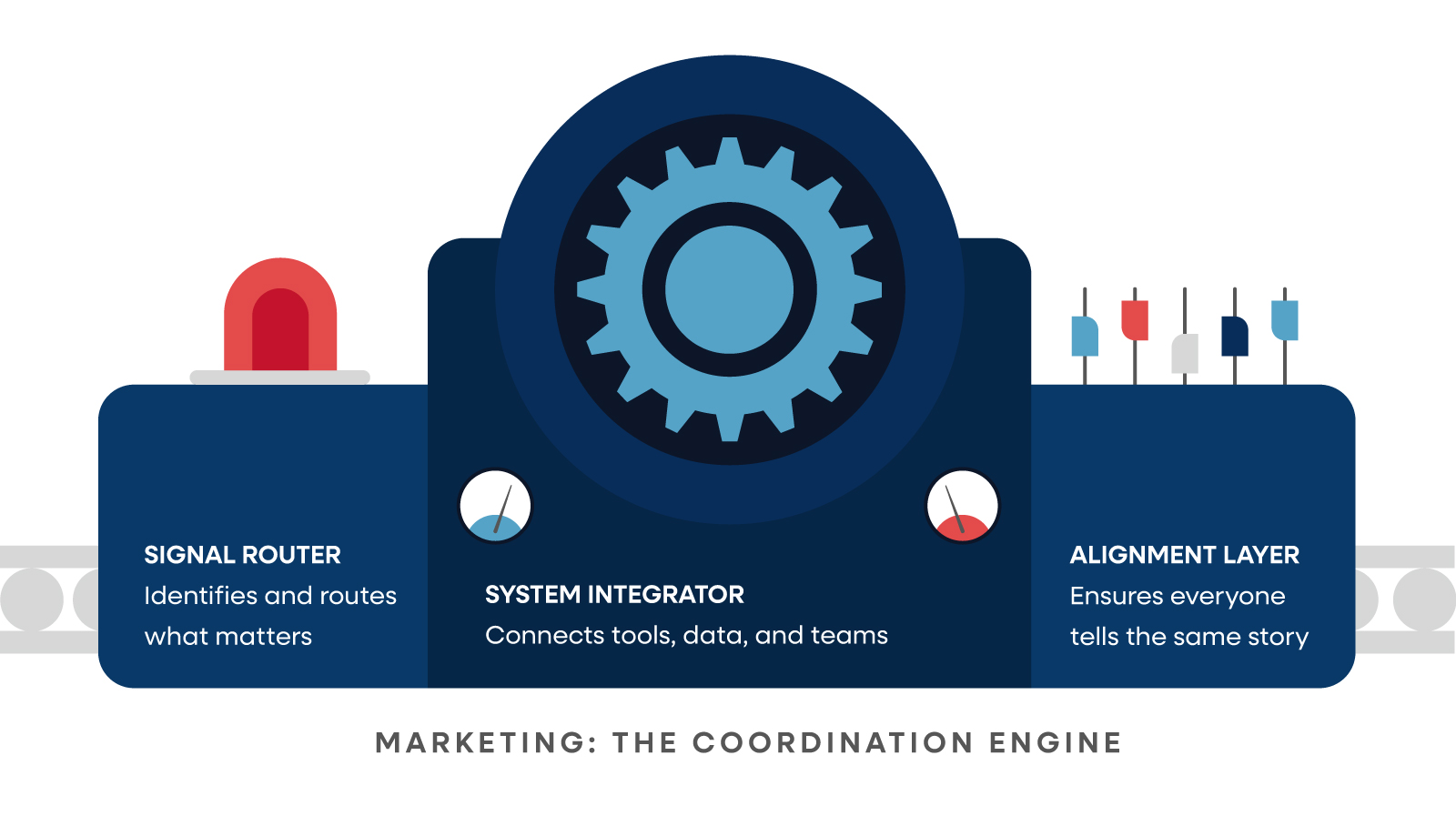
The new challenges of attribution, the shifting of the funnel, and the democratization of thought leadership is forcing marketing into the role of orchestration. Broken down, that means routing signals, integrating systems, and aligning the narrative.
1: The Signal Router
Marketing used to mean running campaigns to generate leads while attribution models assigned credit. Now, marketing must find, analyze, and route signals: actions or data points that prove interest, trust, or fit.
What might that look like across industries?
- In SaaS, an Exposure → Engagement → Conversion rubric and an account-based marketing (ABM) scorecard are a signal-routing framework.
- In manufacturing, Proof Point → Offer Router → Next Best Action sequence demonstrates operational routing.
- In professional services, authority signals (brand mentions, speaking invitations, citations) act as leading indicators of demand that can be mapped to pipeline.
Today’s marketers can’t just create campaigns that push out messages; they must build two-way systems that analyze external signals and action them across the organization.
2: The System Integrator
Buyers now complete most of their journey off-site, invisible to you and your analytics. That creates a coordination gap no single department can close. But marketing can help.
As a system integrator, marketing can unite the tech stack, analytics, and human workflows under one framework.
- SaaS: Marketing + RevOps manage hybrid go-to-market (GTM) motions (product-led + sales-led) with shared visibility into customer journey signals.
- Manufacturing: Marketing matches ERP data (operational proof) with on-site triggers to qualify intent by behavior, not form fills.
- ProServ: Marketing interprets visibility and reputation metrics, turning unmeasurable “influence” into quantifiable authority signals.
As the funnel fragments, marketing is the only team able to pull it back together by connecting buyer intent, operational proof, and financial outcomes into a shared model.
3: The Alignment Layer
Marketing organizes teams around a shared narrative, ensuring sales, CX, product, HR, IR, and leadership speak a common language to the market.
- Enable (and encourage) your experts to publish their insights, driving both narrative consistency and external credibility.
- Help leadership reframe, not just promote, their thinking, building internal trust that flows outward.
- Define new metrics (authority signals, proof-to-close ratio) to create a shared vocabulary for measuring credibility.
The marketing operating system only works if the bridge it builds between teams, data, and the market is reinforced with real expertise. That’s what authentic thought leadership provides.
When credibility flows from actual practitioners, not just branded campaigns, it strengthens every connection: between your message and your market, your story and your proof.
Marketing’s role isn’t to manufacture ideas; it’s to operationalize them. That means curating insight from across the business and making it consistent, visible, and aligned.
What It Looks Like When the Bridge Works
The real magic is when marketing connects the dots from internal reality to external perception and gets all of the teams in your company moving as one.
You are suddenly able to tell the same story consistently across every touchpoint, and put your operational proof out there for the world to see and value. The credibility that creates lowers the cost of growth and improves the efficiency of your revenue engine.
Because when buyers already believe you, you spend less time convincing and more time closing.
- Higher close rates: proof points remove buyer risk
- Faster pipeline velocity: trust shortens buying committee debate
- Lower cost to convert opportunities: credibility reduces friction across the funnel
- Higher retention: buyer expectations match the customer experience
Marketing connects narrative, evidence, experience, and behavior into a repeatable system. The trust built by that system compounds over time, increasing the return of every dollar a company spends.
The Great Marketing Reframe
It’s time to stop treating marketing as a discretionary expense.
Marketing is the operating system that keeps your company coherent (internally and externally) in a fragmenting market.
Buyer behavior is transforming faster than anything we’ve seen before. The new marketing funnel isn’t the death of the old funnel; it’s an explosion, scattering buyer intent across dozens of “invisible” channels.
And unless marketers want our brands’ growth potential to explode, too, it’s time for us to change the way we operate.
AI supported the development of this content, including planning, brainstorming, and outlining, but a human did the writing (and editing).