




Contents:
Why CMOs Are Shifting From Campaigns to Market Intelligence
Why the Traditional CMO Model Is Breaking
The Fork in the Road for CMOs
So—What Is the CMO Role Now?
How This Restores Strategic Authority
A New Operating Model Is Needed
Frequently Asked Questions on the Changing Role of the CMO

Why CMOs Are Shifting From Campaigns to Market Intelligence
The role of the CMO is evolving from campaign management to market intelligence and decision influence. That means the CMO of the future won’t be defined by channel performance or MQL volume but by their ability to interpret signals, identify buying readiness, align teams around what customers are actually doing, and turn insights into business decisions. In other words, the future CMO is a signal architect.
The role of the CMO has changed more in the last two years than in the entirety of my twenty years in marketing. CMOs and marketing leaders are under pressure from a mix of compounding sources: revenue accountability, AI disruption, shorter tenures, and more.
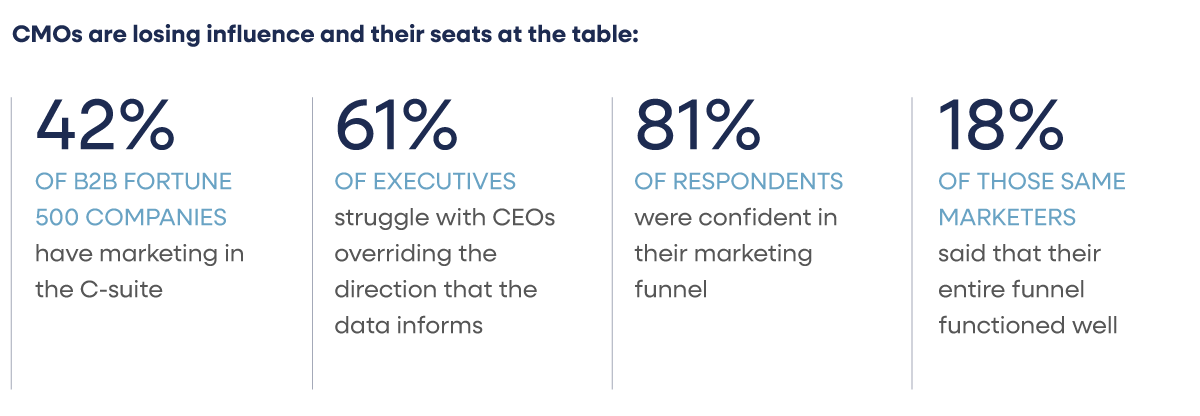
Many CMOs are losing influence and their seats at the table. In fact, just 42% of B2B Fortune 500 companies have marketing in the C-suite (Forrester). And in our recent survey, we found that 61% of executives struggle with CEOs overriding the direction that the data actually informs.
Marketers, we have an authority problem. And an over-confidence one. In our survey, 81% of respondents were confident in their marketing funnel, but as we dug further, only 18% of those same marketers said that their entire funnel actually functioned well.
There’s a disconnect. The traditional CMO role was built around doing: branding, campaigns, growth programs. The role that’s emerging today must instead be built around building intelligence and decision influence—where real authority lives.
Why the Traditional CMO Model Is Breaking
Attribution Limited the CMO’s Role
As a way to anchor marketing to the bottom line, CMOs became accountable for pipeline and revenue. Attribution became our proof mechanism, but it was never intended for (or worked well for) B2B companies.
80% of the marketers we surveyed said that at least one traditional marketing metric needs to be retired, with the second-most cited being attribution models (after lead scoring). The people running the lead gen systems know they don’t reflect reality, and they’re losing faith in them.
That’s because marketing never controlled the pipeline in the first place. CMOs are held accountable for something that they have limited ability to influence. That leaves marketing as a profession reactive and defensive, scrambling to prove something that just can’t be proven.
Revenue accountability without revenue control weakened the CMO’s authority.
AI Is Transforming What Marketing Leadership Means
Meanwhile, AI burst onto the scene and made execution cheaper and faster. Content production and outbound motions now scale easily. The means of production are no longer scarce. Junior marketers and traditional agencies are feeling the impact.
Last year, our survey told us that marketing’s primary use case for AI was content creation. This year, it has fallen behind research and analysis. This is a structural evolution: marketers are evolving from “AI makes me faster” to “AI makes me smarter.”
Our 2026 data suggests senior leaders lean toward AI tool mastery as a key skill for 2030, while practitioners—the ones using these tools daily—place slightly more emphasis on strategic thinking. Agencies, who see across dozens of client scenarios, agree with the practitioners.
The people closest to execution understand that it’s being commoditized. But the people making the hiring and budget decisions haven't internalized that change yet.
The question is: when execution is automated, what does marketing leadership actually lead?
The Fork in the Road for CMOs
The world has already changed, and it will only continue to evolve further. Marketing leaders have a choice to make.
Path 1: The Production CMO
This is the “I’m going to stick with what I know” road. This CMO:
- Oversees campaigns
- Optimizes channel performance
- Manages outputs
Their sphere of influence remains tactical, limited, and undervalued. This role continues to be measured (and valued) on output. And output is being automated away.
Path 2: The Intelligence CMO
This is where things get interesting. This CMO is choosing to exploit the opportunities that AI presents. He or she:
- Interprets and translates market signals
- Aligns sales, product, and marketing around buying readiness
- Informs decision-making for their executives and board
So—What Is the CMO Role Now?
In successful companies, marketing is the bridge. It connects departments within the org, and, more broadly, it connects the company to the market. The CMO’s real job is identifying and translating the signals (behaviors, patterns, trends) that indicate market changes or buying readiness.
The future CMO will be a signal architect above all else.
That means:
- Building (and measuring) readiness and routing to sales at the right time
- Analyzing the market in real time for changes that create threats or opportunities
- Deciding what to do when new trends emerge in the data
The shift is from overseeing execution to gathering and acting on intelligence. It’s about shaping decisions using early indicators of coming change. AI can do a lot, but it can’t define business priorities within context.
Let’s look at a real-world example. In our survey, “community” ranked dead last as a B2B brand trust driver (just 4% of respondents favored it). However, the shifting funnel tells us that community (social media, forums, events) is exactly where B2B trust is increasingly formed.
B2B marketers are overly confident in a measurement system that is nearly blind to the channels that matter most today. This is exactly the type of reality gap that a signal-oriented CMO would identify––and leverage––for their organization.
How This Restores Strategic Authority
The CMO will regain influence when marketing owns:
- Market interpretation
- Early buying signal detection
- Cross-team insights
- Strategic foresight
Boards cut overhead, not intelligence. When marketing is just code for execution, it becomes overhead. But when it acts as the company’s intelligence center, identifying gaps and opportunities before they fully mature, it becomes indispensable.
The Future CMO Is Already Arriving
The CMO of tomorrow will not be defined by how many campaigns they launch, or even how many MQLs they bring in. The future of marketing will be defined by how quickly CMOs are able to see critical changes coming––and how effectively they can translate it into action.
The CMO role is not shrinking, but concentrating into something different: a signal architect.
A New Operating Model Is Needed
A signal architect CMO cannot operate in the old structure. The playbooks, org design, and measurement infrastructure were all built to manage execution, not interpret intelligence.
At a minimum, the shift demands shared signal definitions across functions, rules for what happens when patterns emerge, and AI embedded into feedback loops rather than added on as a production tool. This moves marketing from a campaign builder to an operating system, and that’s a bigger conversation than this article can hold.
We break down what that model actually looks like in practice here: Why Marketing Should Be Your Business Operating System & Bridge.
Frequently Asked Questions on the Changing Role of the CMO
What is the CMO’s traditional role?
Traditionally, CMOs have led brand identity, campaigns, demand generation, customer acquisition, marketing communications, and channel performance. In the old model, CMOs typically didn’t own real-time market intelligence, cross-functional signal interpretation, or strategic decision-making across the business.
How is the role of the CMO changing?
The role of the CMO is now changing from campaign leadership to intelligence leadership. As AI makes execution faster and cheaper, the CMO’s value shifts from managing marketing output to understanding what the market is signaling and translating that into action.
What skills will the CMO of the future need?
Future CMOs will need strategic judgment, AI fluency, data skepticism, market interpretation, customer understanding, and cross-functional influence. Tool mastery matters, but the larger skill is knowing which signals matter and how that data should inform business decisions.
Is the CMO role becoming less important?
No, CMOs are not losing their place in the organization. Instead, the role is becoming more concentrated, focusing on judgment, foresight, and the ability to connect market intelligence to business strategy. Companies need leaders who can interpret market change and guide decisions before competitors, customers, or revenue conditions force a reaction—and that makes CMOs more important than ever.